Archie's menagerie
The Girl he Never NoticedArchie's menagerie is a fenced animal compound at Yewarra and one of the clearest material expressions of the care Cameron Hillier gives his adopted nephew, Archie. Built to answer a child’s intense interest in animals, it is also an environment in which grief is made manageable, children learn to share attention, and Liz Montrose’s relationship with the household becomes emotionally concrete. The menagerie begins as Archie’s private kingdom but grows into a living centre of the wider family circle.
Design and Inhabitants
Archie's menagerie stands not far from the house in a fenced compound covered with netting and shaded by shrubs inside and outside the enclosure. Old hollow tree trunks provide natural-looking shelter, while gravel paths organize the space. Its arrangement is more deliberate than a collection of pets kept in improvised boxes: Cameron Hillier has made a place suited to the animals and to Archie’s curiosity.
The compound contains rabbits in hutches and a family of guinea pigs housed in a remarkable castle-like cage equipped with climbing wheels, slides, and bells. A white cockatoo with a sulphur crest knows a limited repertoire, including “Hello, cocky!” and “Oh, golly gosh!” A pond with a small waterfall, slippery stones, and surrounding greenery gives six frogs a habitat of their own, while another pond contains goldfish. Archie also takes particular pride in Wally, his blue-tongued lizard, whose cave becomes the focus of an absorbing game when Liz and Archie try to entice him out.
The menagerie’s detail matters because it shows that Archie’s animals are not merely decorative background. The enclosures, paths, shade, water, and play equipment embody an adult’s sustained labour, while the named animals and their habits give Archie a vocabulary of kinship and responsibility. He introduces Golly and Ginny as a married pair and points out their offspring, turning observation into a child’s model of family life.
Cameron Hillier’s Care and Archie’s Grief
When Liz asks whether Archie created the compound, Archie answers that he is only five and that Cameron did most of it, although Archie helped. Cameron later explains that Archie has always been interested in animals, so he decided that properly constructed surroundings would be better than mice kept in shoeboxes. The remark combines practical judgment with an instinct to respect the child’s passion rather than suppress it.
Cameron also recognizes that the menagerie has a therapeutic function. Archie is the orphaned son of Cameron’s sister, and Cameron has adopted him; he says that the animal compound has helped the boy recover from the loss of his mother. The place therefore operates as a form of everyday grief care. It does not erase Archie’s bereavement, but gives his feelings a rhythm of feeding, watching, naming, protecting, and coping with the unavoidable separations that come with living creatures.
Archie’s sensitivity is visible in his reaction when five of Wenonah’s puppies are sent to new homes. He scarcely eats for a day and cannot sleep that night, an intensity that shows how deeply he invests in animal attachments. Cameron’s responses extend beyond the compound itself: he sends Archie postcards, books, and strange or wonderful objects from different parts of the country and overseas, which Archie keeps with great pride in a special cabinet. One such gift is a full-sized boomerang. Archie threw it indoors, broke a window, and became distressed until Cameron found him the song “My Boomerang Won't Come Back.” The menagerie belongs to the same pattern of care, in which Cameron turns accidents, losses, and strong feelings into experiences Archie can survive and remember with pleasure.
A Meeting Place for Liz Montrose, Scout, and Archie
Liz’s first experience of the compound changes the tone of her visit to Yewarra. Archie leads her along the path, hands her a guinea pig, and explains the animals with solemn authority. She is enchanted, especially because she immediately thinks how much her daughter, Scout, would enjoy the place. That response links the menagerie to Liz’s own identity as a mother: her attention is drawn not only to Archie’s delight but to the possibility of bringing Scout into it.
The animals quickly create intimacy between Liz and Archie. They kneel together laughing as they try to lure Wally the blue-tongued lizard from his cave, and Liz apologizes only because she has become so absorbed in the experience. Her enjoyment is not a performance for Cameron or an extension of her work; it is spontaneous participation in Archie’s world. The menagerie allows her to meet him on his own terms before she has fully understood the responsibilities of her position at Yewarra.
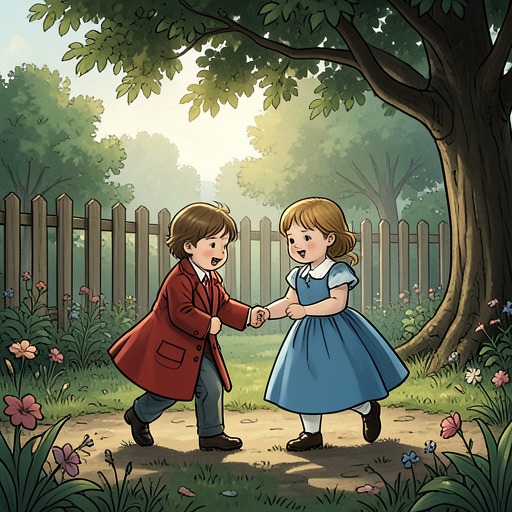
The same space helps Scout and Archie move from hesitation toward companionship. Archie initially regards himself as the senior child at Yewarra and, as the owner and architect of the menagerie, dictates what the children should do. Scout is wary of him at first. Yet the household repeatedly uses shared play to soften that hierarchy. Liz and Daisy Kerr organize games for both children, including an imitation of elephants inspired by the birth of a real baby elephant at Taronga Zoo and the recording of “Baby Elephant Walk.” The children join Liz and Daisy in pacing around the playroom with their arms held like trunks, and the game becomes a favourite. Although this scene takes place outside the compound, it extends the menagerie’s social function: animals supply the imaginative language through which the children become allies.
The compound remains the place to which that attachment returns. After Liz’s absence, Archie tells Scout that Golly and Ginny have had more babies and invites her to see them. Scout agrees, and the two race together toward the menagerie. The animals thus provide an immediate shared interest that no adult needs to impose; they give the children a reason to resume their partnership and a familiar world in which reunion can become play.
Place in the Yewarra Household
Archie's menagerie also helps Liz settle into her work at Yewarra. She establishes a computer program for the stables and often takes Scout and Archie with her to inspect the foals born on the property. The children invent names for the young horses as they watch them change from stiff-legged newborns into lively, confident animals. The menagerie and the stables together turn Yewarra into a landscape of observation and care, one in which work, education, and family recreation overlap.
This arrangement is important to Liz because her position initially carries a clear professional boundary. She is employed to help manage the estate and to provide the right influence in Archie’s life, while Cameron is her employer. Yet the children’s animal-centred activities draw her into the household’s emotional structure. Cameron has chosen her partly because he has seen how Scout’s name warms her and how naturally she responds to Archie. The menagerie offers visible proof of the kind of influence he hopes she can provide: attentive, playful, and capable of making safety and happiness feel ordinary.
The compound also fits a broader pattern in which adults construct homes through acts of care. Cameron’s mother had preserved refinement and a love of gardens despite a difficult life with Cameron’s father, and Cameron describes the gardens at Yewarra as a tribute to her. The menagerie is a different but related tribute to the needs of a child. Where the garden expresses an inherited ideal of beauty, the animal compound expresses Cameron’s practical adaptation of that inheritance for Archie’s grief, imagination, and development.
Emotional and Narrative Significance
The menagerie is significant because it makes attachment visible through living systems rather than declarations. Animals must be housed, watched, and released or rehomed; their births and losses cannot be entirely controlled. Archie’s distress over the puppies, pride in his cabinet of gifts, and delight in new guinea-pig offspring reveal a child learning that love includes both stewardship and separation. Cameron’s contribution shows an adult responding to orphanhood not with a single grand solution but with an enduring structure of attention.
For Liz, the menagerie becomes an emotional threshold. She enters it as a professional visitor, yet emerges laughing on her knees beside Archie, already imagining Scout’s pleasure. Through that scene, Archie’s private refuge becomes a shared social space and Liz’s connection with the boy becomes harder to regard as merely part of her employment. The compound also gives Cameron a way to witness Liz’s aptitude with Archie without turning the observation into a formal test: he sees the ease with which she joins the child’s play.
By the time Liz returns to Yewarra with Cameron and Scout, Archie’s fear is not simply that Liz might leave a job; he asks whether she will go away again and says that nothing feels the same when she is absent. His reassurance is followed immediately by the invitation to see the new guinea pigs. That movement from anxiety to shared animal discovery captures the menagerie’s lasting role. It is Archie’s refuge, Cameron’s act of guardianship, and the children’s route into companionship; at the same time, it becomes one of the places where Liz’s temporary presence is transformed into a promise of belonging.